










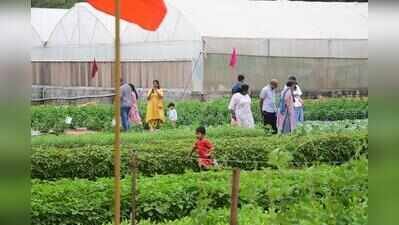
Bengaluru: With rapid urbanisation widening the disconnect between food production and consumption, many children growing up in cities have little opportunity to visit farms or understand the journey of food from seed to plate. Seeking to bridge this growing knowledge gap in urban areas, the College of Horticulture under the University of Horticultural Sciences, Bagalkot, has created a unique ‘Crop Museum’ at the ongoing three-day Sasya Santhe (Sapling Fair) at Gandhi Krishi Vigyan Kendra (GKVK) near Yelahanka.Spread over 1.5 acre venue, the living museum has close to 60 varieties of vegetables, flowers and fruits under cultivation, offering visitors, especially children, a peek into the fascinating world of horticulture. “Unlike a conventional museum, where exhibits are displayed behind glass, the crop museum allows visitors to walk through dedicated plots featuring living plants and observe how different horticultural crops are grown,” said BS Lakshman Reddy, a professor at the college.B Anjaneya Reddy, associate professor at the university, said, “The initiative has been designed to offer urban children hands-on exposure to farming, especially the cultivation of vegetables and fruits, and help them understand the origins of the food they consume every day. We have also allowed children to harvest leafy greens at the museum, as it will help generate curiosity about gardening and horticulture and give them a glimpse into the lives of farmers.”A research student at the university said most children in urban areas are accustomed to seeing vegetables neatly arranged on supermarket shelves or delivered to their doorsteps, and the Crop Museum offers them an opportunity to discover the effort and agricultural processes involved in bringing food to their plates.“We have raised three varieties of tomatoes and two varieties each of brinjal and chilli, along with other vegetables such as bendekayi (okra), ridge gourd, snake gourd, cabbage, turnip, radish and pole beans, besides six varieties of leafy vegetables. About 20 varieties of flowers and medicinal plants are also part of this museum,” the researcher said.Since Friday, thousands of schoolchildren have visited the museum, according to officials.