



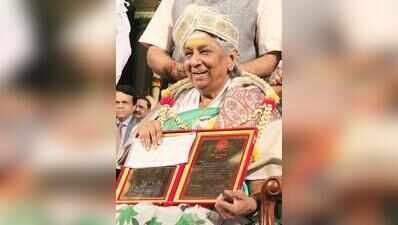
Bengaluru: Through the swinging 60s, colourful 70s, stormy 80s, and sizzling 90s, heroines came and went, new faces lit up the silver screen, and Kannada cinema reinvented itself with every generation. But one voice remained a constant. From Jayanthi and Kalpana to Juhi Chawla and Khushbu, S Janaki sang for generations of leading ladies, effortlessly becoming the woman on screen every time she stepped behind the microphone. That was the magic of the ‘Gaana Kogile’ (nightingale) — she did not merely lend her voice to an actress; she became her voice.Alongside S P Balasubrahmanyam, Janaki ruled the airwaves and captured the hearts of generations of Kannada music lovers, leaving behind a musical legacy in which the stars on screen changed, but the voice behind them remained unforgettable.Lyricist Kaviraj explains this versatility thus: “For listeners, she was Bharathi, Jayanthi, Kalpana or whoever the actress was. Her voice felt like that of the actors who were seen performing those songs on screen. The same was true of SP Balasubrahmanyam, whose voice would feel like that of Vishnuvardhan, Shankar Nag or whichever hero was performing the song in the film.”Thus, while she was the most sought-after female playback singer in Kannada during the 1960s and 1970s, her versatility helped her sustain her prominence through 1980s and 1990s.PBS-S Janaki and SPB-S JanakiHer contemporary and another legendary female playback singer, P Susheela, had a distinct voice that listeners immediately identified with the singer. The same was true of PB Srinivas. His voice was particularly associated with Dr Rajkumar. But S Janaki could effortlessly modulate her voice to suit virtually every actor. So much so that some of her most popular songs in Kannada include those she sang for child artistes.Before SPB became the de facto voice of several Kannada male stars, thanks to his ability to modulate his voice to suit different actors in the 1970s and 1980s, S Janaki had already established herself as the de facto voice of virtually every female star in Kannada cinema. Her career spanned the peak years of both PBS and SPB in Kannada cinema. When Dr Rajkumar returned to singing for his films in the 1970s, S Janaki was again the default choice for duets.Interestingly, though she made her debut in Tamil cinema — having been born into a Telugu-speaking family in Guntur and later moving to then Madras — her early career blossomed in Kannada and Malayalam films. It was during the Ilaiyaraaja era that she truly came into her own in Tamil cinema. Before that, her songs for Kannada film composers such as GK Venkatesh, Upendra Kumar and Rajan-Nagendra had made her as popular as the leading actors of Kannada cinema. She also sang a significant number of her songs in Kannada.Her Biggest GrouseDespite all her popularity and contribution to the Kannada film industry, by the turn of the century, S Janaki had won four National Film Awards and more than 20 State Film Awards, but not a single Karnataka State Film Award. She publicly expressed her sadness over not having received an award from the Karnataka govt until then.Ironically, she had sung an Odia song composed by Kannada music director Upendra Kumar and won an award from the Odisha govt, a fact she recalled in 2002. As if to make amends for the oversight, the Karnataka govt bestowed the Rajyotsava Award on S Janaki in 2014. While receiving the award, the legend mentioned that it was her first award from Karnataka despite having sung the maximum number of songs in Kannada, followed by Malayalam.Toughest SongS Janaki has sung thousands of songs in Kannada, including film songs and compositions in other genres. The “Gaana Kogile” excelled not only in duets but also as an independent female playback singer. In Kannada, she has rendered some of the most memorable solo songs.In a recent interview, the singer described “Shiva Shiva Ennada Naligeyeke?” from the 1977 Kannada film Hemavathi, directed by Siddalingaiah, as the most difficult song of her career. With lyrics by Chi Udayashankar and music composed by L Vaidyanathan, the song, which blended two classical ragas, posed a formidable challenge that she ultimately mastered.She declined Padma Bhushan, cherished fansIn 2013, S Janaki declined the Padma Bhushan, India’s third-highest civilian honour, saying it had come too late and felt too little after a career spanning more than five decades and over 45,000 songs. Her decision also reflected a long-standing sentiment among some South Indian film personalities, who felt that artistes from the region had not received adequate recognition through the Padma Awards compared with their counterparts in Hindi cinema.A year later, while accepting the Rajyotsava Award from Karnataka, Janaki gave a memorable tribute to her fans. As she sang one of her iconic songs, Omme Ninnannu Kantumba Noduvaase, she changed the final word “elliruve” (“where are you?”) to “illiruve” (“you are here”), stretching out her arms towards the audience. The gesture conveyed that the honour she truly cherished was the love and recognition she received from her fans.Famous Solo Hits• Nagu Endide • Moodala Maneya • Hoovinda Hoovige• Indu Enage Govinda • Karedaru Kelade • Ninna Roopa Edeya • Aa Aa Ee Ee KannadadaDuets with PBS• Thamnam Thamnam Nanni Manasu • Raja Muddu Raja • Malenaada Henna Maibanna • Raja Muddu RajaDuets with Dr Rajkumar• Tanuvu Manavu Indu • Alli Illi Noduve Eke? • Ee Mounava Taalenu • Elleli NodaliDuets with SPB• Ee Sambashane • Kangalu Vandane Helide • Neeniralu Joteyalli • Cheluve Ondu Keltini