










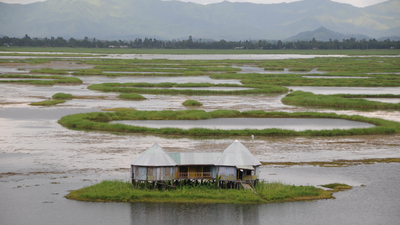
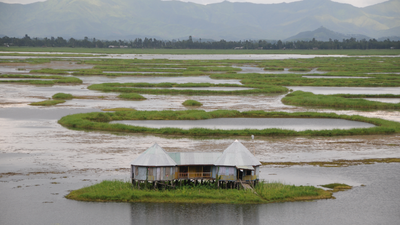
The northeastern state of Manipur contains the amazing freshwater body of Loktak Lake, known for its perfect circular floating islands called phumdis. The phumdis, which are masses of vegetation, soil, and organic matter, form an incredibly unique landscape that can be seen from outer space. Referred to as India’s “floating lake”, the Loktak Lake contains the Keibul Lamjao National Park, the only floating national park in the world. In addition to its uniqueness, the lake hosts some rare species of wildlife, such as the king cobra, which is considered one of the longest venomous snakes in the world.
The mystery behind Loktak Lake’s floating islands
There is no other lake in India like the Loktak Lake. Occupying an area of about 287 square kilometres, the lake has natural floating islands known as phumdis, which are made up of decomposed vegetation, roots and organic materials that eventually accumulate together.According to experts from TERI, what makes the phumdis special is their capacity to float on the lake surface while being robust enough to be used as human settlements, fishing huts and even animal habitats. In dry seasons, certain parts of the floating islands sink into the lake bottom for nutrient absorption and rise up once there is more water.In one of the studies carried out by UNESCO, it was established that the lake is recognised as a nutrient globally due to its hydrology and ecological significance. The study referred to the phumdis as “a heterogeneous mass of vegetation, soil and organic matter at various stages of decomposition”.Scientists have been studying the formation and movements of the circular floating islands for decades now. Their constant movement causes them to form a changing landscape.
The world’s only floating national park
The Keibul Lamjao National Park is found in Loktak Lake, and it is the only national park in the world that floats. It is found in floating islands and is home to the endangered sangai deer, popularly known as the brow-antlered deer.According to the description provided by the Manipur Forest Department, the Keibul Lamjao National Park is a “globally unique wetland ecosystem”. These floating grasslands act as a habitat to migratory birds, reptiles and aquatic animals in the lake.It has been warned by scientists that hydrological alterations as well as climatic factors pose a threat to the phumdi ecosystem, because, if the floating masses become too thin, then the animals inhabiting them might be endangered.There have been many appeals made by conservationists, such as those from Wetlands International South Asia, to conserve the ecosystem in the lake sustainably.
Loktak lake and the king cobra connection
Among the most interesting creatures found in the wetlands near Loktak Lake is the king cobra, whose scientific name is Ophiophagus hannah. King cobras live in forested and wetland habitats in certain areas of India and South-East Asia.The king cobra is the largest venomous snake in the world and can grow up to 5.6 meters long. Some individuals are as long as 18 feet, according to the Centre of Advanced Study in Life Sciences, Department of Life Sciences, Manipur University. Thus, it is considered one of the longest snakes in the world.Though the king cobra is frightening, it is not aggressive and usually avoids contact with humans. King cobras are very important as predators because they control the population of other snakes.The wetlands and thick vegetation around Loktak Lake serve as a perfect shelter for reptiles, amphibians and aquatic animals, thus being one of the most biodiverse places in India.Loktak Lake is among the most wonderful natural wonders in India today because there are floating islands moving across the lake and ancient animals living under the hills of Manipur.