






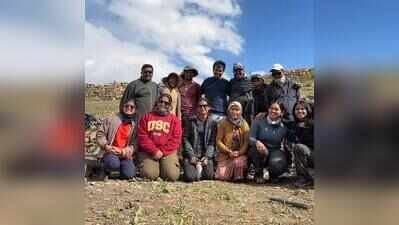
Udupi: Hiking through remote Himalayan forests, cycling across one of India’s toughest high-altitude routes and building a greenhouse at 4,400m above sea level were among the challenges undertaken by students of the MAHE during the Centre for Outdoor Studies ‘Summer in the Himalayas’ programme.Conceptualised by Prof Ganesh Nayak, founder of the Centre for Outdoor Studies, the initiative combined three experiential learning programmes: independent alpine hiking, high-altitude cycling and a community service project in Spiti Valley. Prof Nayak told TOI the centre deliberately opted for an independent hiking format, with students handling navigation, camping, cooking and logistics. The route from Kullu to Parashar lake was identified after an exploratory visit to Himachal Pradesh and consultations with Himalayan explorer Peter Van Geit. Although Prof Nayak’s initial recce ended about 10km short of the lake because of difficult terrain and exhaustion, it helped refine the route for the student expedition.A team of five students underwent acclimatisation training in Manali before beginning the trek. Rain, blocked trails and the evacuation of one participant due to illness tested the group, but with support from locals, who provided food, water and alternate routes, the remaining students completed the trek from May 25 to June 2.Based on the experience, the centre plans to introduce independent hiking programmes in Karnataka to train students in camping, navigation and expedition skills before undertaking more challenging Himalayan expeditions.According to Prof Nayak, the second expedition from June 4 to 13 saw six students cycle from Manali to Spiti Valley via Kunzum Pass, one of the most demanding cycling routes in the Indian Himalayas. The route climbs nearly 2,000m in just 100km to an altitude of about 4,500m, making acclimatisation essential. The team negotiated gravel roads, river crossings, freezing temperatures and basic accommodation at temporary camps and roadside dhabas.“All six were first-time Himalayan cyclists but had trained with the Centre for periods ranging from six months to two years. Interestingly, three bicycles used during the expedition were assembled by students and staff at the Centre’s bicycle laboratory at MIT, Manipal. After months of testing in local conditions, the bicycles performed exceptionally well,” Prof Nayak said.The third programme from June 15 to June 23 focused on community service. In collaboration with Spiti Ecosphere, five students, including two from MAHE Bengaluru, travelled to Demul village in Spiti Valley to build a greenhouse using sustainable construction techniques. Prof Nayak said the project also hosted students from the University of Utah for a day, paving the way for future collaborative sustainability initiatives involving MAHE, the University of Utah, and local communities in Spiti Valley.Veer Morparia, a first-year student at MIT, MAHE, said: “The programme taught us to be comfortable with discomfort. Spending a week in areas without internet significantly boosted my confidence. We were six of us on the Alpine hiking programme, including Prof Ganesh Nayak. The hike was held from May 29 to June 2, and it was an incredible experience. We carried everything ourselves, including food, tents and cooking equipment, making it a completely self-sustained expedition. We trekked an average of about 8km each day, starting in the morning and reaching our campsite by afternoon. We also carried essential medical equipment such as blood pressure monitors and pulse oximeters to keep track of our health at high altitudes.”Julin Varghese, student team leader of the cycling expedition, shared his experience, “This was one of the toughest expeditions we have undertaken. The team remained united throughout, with no conflicts, and everyone pushed through the most challenging days together. The rapid gain in altitude made acclimatisation particularly difficult, but reaching Kunzum Pass was an unforgettable moment. We were beaming with happiness. The greenhouse project was equally rewarding because we realised we were contributing to something that would make a real difference, and being part of this journey was truly fulfilling.”Meanwhile, Isha Sulochana TAPMI, Bengaluru said: “The main purpose of the programme was to help build a greenhouse in Demul. While the mountain environment was completely new to me, community service was not. What made this experience truly special was the opportunity to connect with the local people. I fell ill from the high altitude, but my host mother took wonderful care of me, making me feel at home. We learnt about each other’s cultures, enjoyed nutritious local cuisine and experienced how everything is built from scratch using locally available materials. Watching the community come together to help one another was inspiring. The harmonious way of life is in contrast to the fast-paced lifestyle in cities.”