









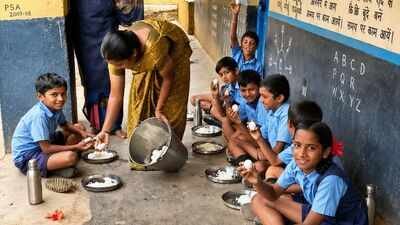
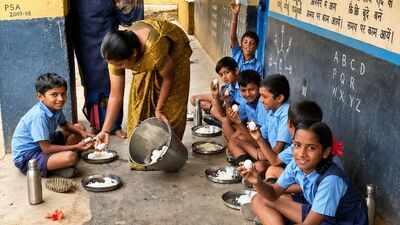
Awareness campaigns and pilot programmes have seen more students opt for eggs in their midday meal, with the state govt doubling down on evidence linking it to stronger health and nutrition outcomes West Bengal’s move to exclude eggs from midday meals has revived a familiar debate over nutrition, food choices and religious sensitivities. Karnataka’s experience, however, shows that the issue need not be reduced to a simple eggs-versus vegetarian-food binary.After years of political opposition, objections from religious groups and administrative hurdles, eggs have become a regular part of school meals in Karnataka. Around 65% of the 47 lakh children enrolled in govt and aided schools now opt for eggs, while the rest are offered bananas.The proportion choosing eggs was about 50% in Sept 2024, but has risen since eggs began to be served on all six school days instead of twice a week.
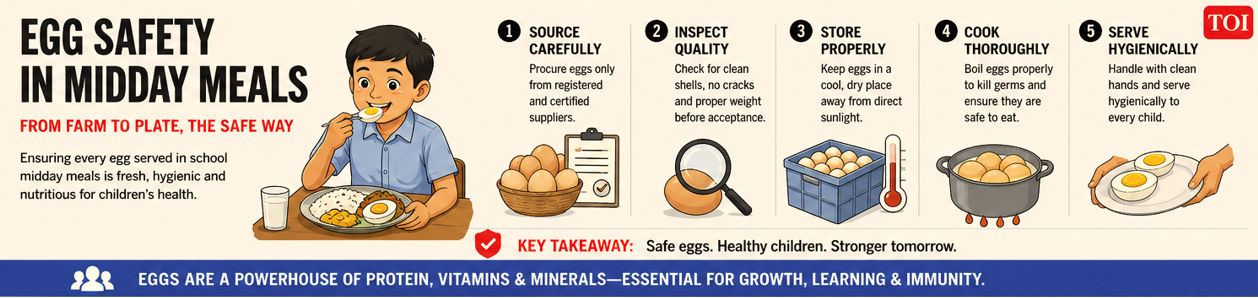
Getting the message acrossOfficials in the school education department attribute the rise in egg consumption partly to campaigns explaining their nutritional value. Videos, posters and other awareness material are regularly circulated in schools, while officials have been asked to engage directly with parents in areas where uptake remains low.“The biggest challenge continues to be resistance from certain communities due to caste practices, religious beliefs and festival-related customs. Food habits are deeply rooted in culture, so participation cannot be forced. Our role is only to create awareness. We hope egg consumption will rise to 80-85% by next year,” said a senior official in the department.The programme remains voluntary. Schools serve eggs only after obtaining written consent from parents, and children who do not eat them are offered alternatives.A pilot born of a crisisThe turning point came in Dec 2021, when eggs were introduced under a centrally sponsored initiative to tackle malnutrition.Seven of Karnataka’s 31 districts qualified for the intervention. The proportion of children affected by malnutrition and anaemia in those seven districts ranged from 68% (in Vijayapura) to 74% (in Yadgir). The pilot covered 14.4 lakh students from classes 1 to 8.The programme cost roughly Rs 40 crore, of which the Centre bore 60%. Eggs were provided for four months at Rs 6 per child, on 12 days each month. Schools also monitored children’s height and weight.The decision immediately ran into opposition. Several religious leaders and mutts urged the BJP govt then in office to withdraw it.The Lingayat Dharma Mahasabha said it did not oppose people eating eggs but objected to their being served in schools. Other organisations also demanded a reversal.The govt allowed the pilot to continue, and the evidence that followed strengthened the case for expansion.

Evidence shifts the debateThe Karnataka State Rural Development and Panchayat Raj University studied 9,000 children in 60 schools. Half were in Yadgir, where children received eggs or bananas, and the rest in Gadag, where eggs were not served. Among girls in Yadgir, 86% gained between 0.9kg and 3.6kg. Boys recorded average weight gains of up to 1.7kg more than their counterparts in Gadag.The school education department also reported a 6-7% rise in attendance on days when eggs were served. More than 91% of the children preferred eggs, while the rest chose bananas or chikki (peanut brittle).Encouraged by these findings, the Basavaraj Bommai-led BJP govt expanded the programme to all districts in July 2022, providing eggs twice a week under the PM Poshan Shakti Nirman scheme.The programme was scaled up again in 2024 under the Congress govt led by Siddaramaiah, with eggs being served on all six school days. The expansion was supported by a Rs 1,500-crore grant from the Azim Premji Foundation, which agreed to fund the additional four days for three years.Expansion brings new issuesThe increase in egg days has also exposed weaknesses in the programme’s design.In urban areas, schools commonly depend on NGOs to supply midday meals. Some do not serve eggs, leaving school authorities to make separate arrangements. Headmasters and teachers must identify vendors, procure eggs and ensure that they are cooked and distributed.The reimbursement given stands at Rs 6 per egg. Actual prices often exceed that amount, forcing some headmasters and teachers to pay the difference themselves. Procurement and preparation have also added to teachers’ duties.Implementation remains uneven. A random audit by the Azim Premji Foundation found that 560 of 762 sampled schools were not serving eggs every day despite the sixday mandate.Social resistance has not disappeared either. There have been instances of children leaving schools after eggs were introduced. Eleven schools in Dakshina Kannada said they could not serve eggs because they operated on the premises of temples or religious institutions.Acceptance, but no certaintyFor activists who have long campaigned for eggs in midday meals, the programme’s growing acceptance is encouraging.“The only protein available at a reasonable price is eggs. Other protein sources such as almonds and cashews are far more expensive. It has been proved that the only feasible solution is eggs. Now, there has been some consistency in the state regarding the distribution of eggs. It should continue irrespective of the political leanings of the govt in the future, too,” said V P Niranjanaradhya, an educationist.The programme has survived changes in political leadership: it began as a limited intervention under a BJP govt, expanded statewide under the same administration and was scaled up further by Congress.Yet campaigners argue that it still does not rest on a secure foundation. Public health specialist Dr Sylvia Karpagam also questioned why schools must separately procure eggs when meal providers do not supply them.“The responsibility (to provide eggs) is with school development and monitoring committees, who have given it to headmasters and teachers. Why should teachers be sitting and boiling eggs? A lot of teachers are now resistant to the idea,” she said.
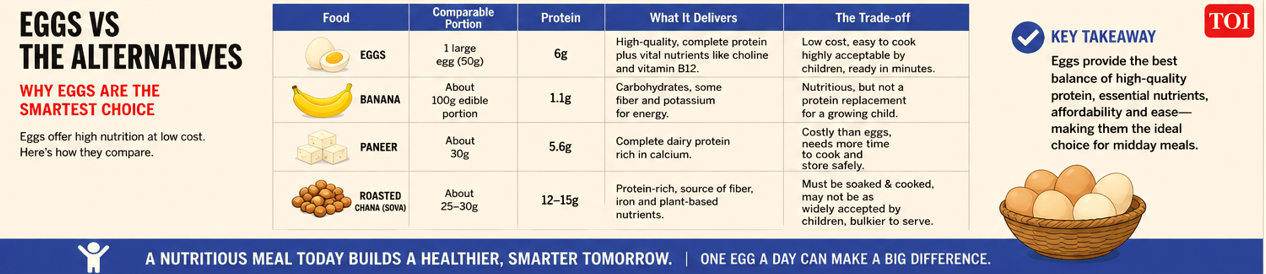
A question of choiceResearch by Azim Premji University has also supported the inclusion of eggs in school meals, both for their nutritional value and because they can be supplied at scale.“It is well known that eggs are not just nutritious, but also logistically feasible to provide at such alarge scale. However, it is not provided across the country… It’s not that the majority of the country are vegetarians. While vegetarians should be given alternatives, those who are willing should get eggs,” said Dipa Sinha, faculty at the Centre for the Study of the Indian Economy, Azim Premji University, who has co-authored the mid-day meal study.Karnataka’s experience suggests that eggs and vegetarian alternatives can coexist. Children are not compelled to eat eggs, and alternatives remain available to those who do not want them.The larger obstacle is financial. The cost of eggs is borne largely by states, whose ability to fund midday meals varies considerably.Noting that “it’s the state govts which are spending extra for the eggs”, Sinha said “given that states’ finances are stressed and spending capacity is uneven across states, the national allocations for midday meals should increase so that eggs can be provided in poorer states as well”.Karnataka has not eliminated the political, religious or logistical disagreements surrounding eggs. But it has shown that those disagreements need not prevent children who want eggs from receiving them. Its model rests on a simple principle: preserve choice for families, offer suitable alternatives and allow evidence on nutrition and attendance — rather than ideology alone — to guide school food policy.