










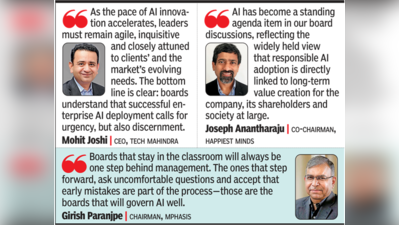
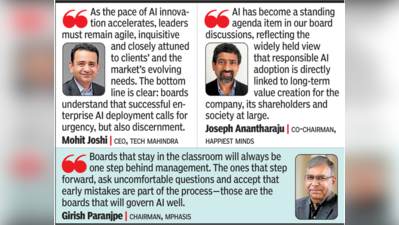
Bengaluru: Corporate boardrooms are witnessing a quiet but significant shift: directors are becoming AI’s newest apprentices. The change reflects a growing recognition that AI’s impact extends far beyond technology. Directors are increasingly seeking a deeper understanding of how the technology can reshape operations, improve productivity and alter competitive positioning. In many companies, AI has become a standing agenda item, with boards taking a far more active role in deciding where to deploy the technology, how quickly to move and how to manage the associated risks.“Over the last 12-18 months, the nature of boardroom conversations around AI has changed significantly,” said Mohit Joshi, CEO and managing director of Tech Mahindra. “Earlier, AI was largely viewed as a technology or innovation initiative. Today, the focus is more business-driven, centred on competitiveness, operational efficiency, customer value, risk management and long-term growth.”According to Joshi, boards now want to understand how quickly AI can move from experimentation to delivering measurable business outcomes. Leadership teams and directors are becoming increasingly involved in shaping AI strategy, governance frameworks, data readiness and operating models.The shift is visible across industries. At Happiest Minds, AI is no longer viewed as the domain of technology leaders alone. “AI was once seen as the domain of the CTO and CIO. Today, its transformative impact on markets and business models is too fundamental to be treated as an isolated technology initiative,” said Joseph Anantharaju, co-chairman of Happiest Minds. “It is now firmly established as a core strategic priority at the board level.”At Happiest Minds, AI has become a standing agenda item in board discussions, reflecting what Anantharaju described as the widely held view that responsible AI adoption is directly linked to long-term value creation for companies, shareholders and society at large.The company has embedded AI into strategy reviews and capital allocation decisions. Founder and chairman Ashok Soota personally leads the company’s “AI First” programme, while its generative AI business has been elevated into a dedicated business unit under the leadership of chief technology officer Sridhar Mantha. The company also assesses how each business unit and enabling function is leveraging AI to drive competitive advantage and sustained differentiation.The growing engagement of boards with AI comes as companies grapple with questions around risk, accountability and governance.Mphasis chairman Girish Paranjpe said the debate over whether AI will reshape businesses is over. The real challenge is determining where to begin and how fast to move.“In my experience, the limiting factor is rarely budget or technology; it is the board’s and organisation’s appetite for risk,” he said. A heavily regulated company may start by deploying AI in back-office functions and keeping humans firmly in the loop, while a market-first company may use AI autonomously and much closer to customers.“Neither is wrong — what matters is that the choice fits the organisation’s reality,” Paranjpe said, adding that boards must make these choices consciously and take ownership of them.As AI adoption accelerates, directors are also having to learn an entirely new vocabulary around data governance, model risks, cybersecurity and responsible deployment. Companies are increasingly organising workshops, expert briefings and strategy sessions to help boards build familiarity with the technology.But executives argue that theoretical knowledge alone is not enough. Paranjpe believes real understanding comes only through experience. “Boards that stay in the classroom will always be one step behind management. The ones that step forward, ask uncomfortable questions and accept that early mistakes are part of the process are the boards that will govern AI well,” he said.For many boards, the immediate focus is on practical issues such as data readiness, cybersecurity and governance frameworks. Joshi said directors are setting priorities around assessing whether enterprise data is AI-ready, implementing robust protocols to counter cyber threats and updating policies to ensure the safe and responsible integration of AI into core business processes.“The emphasis is on disciplined execution, data integrity, cybersecurity and measurable business outcomes,” Joshi said. “Striking the right balance between speed and sound judgment is critical.”The message emerging from corporate India is increasingly clear: AI governance can no longer be delegated. As enterprises move from experimentation to large-scale deployment, directors themselves are becoming active participants in shaping AI strategy — learning, experimenting and asking difficult questions.