










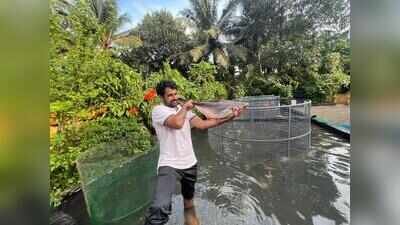
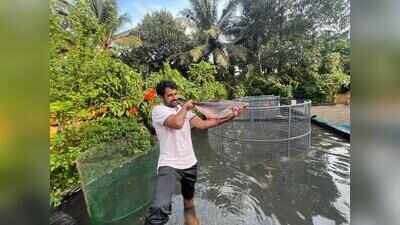
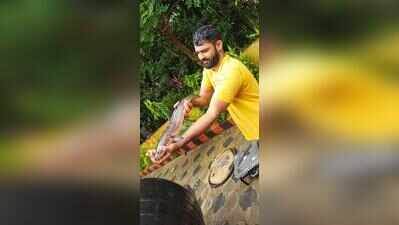
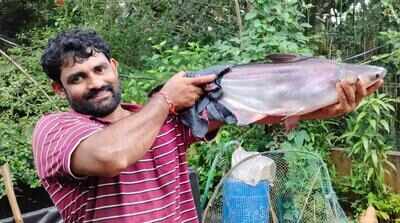
Mangaluru: A farmer from Moodubidire has successfully transformed uneven and hilly terrain into a productive aquaculture venture. Rajesh Kotian, who began fish farming around seven years ago, has now built a sustainable and profitable model by integrating traditional agriculture with scientific fish rearing practices.Mainly engaged in agriculture, including areca and paddy cultivation, Kotian ventured into fish farming during the Covid-19 period, with an investment of Rs 3.5 lakh. “We wanted to try something new, and explored how to start fish farming. With guidance from the Krishi Vigyan Kendra, we developed ponds and gradually expanded it,” he said.Now Kotian rears multiple fish varieties such as murrel, rohu, roopchand, catla, pangasius and other species. His farm supplies fresh fish directly to customers, with daily sales depending on demand. On average days, about 4–5 kg is sold, while on weekends, especially on Saturdays and Sundays, sales rise to 25 kg–30 kg.During special events like the ‘Matsya Mela’ organised at his farm, sales have exceeded 100 kg over two days. During the ‘Matsya Mela’, Kotian collaborates with institutions like Krishi Vigyan Kendra, the fisheries department, and the Fisheries College in Mangaluru, to provide technical guidance to visiting farmers.Unlike normal fish markets, Kotian reaches out directly to consumers. Customers visit his farm from Mangaluru, Padubidri, and nearby areas, select live fish of their choice, and get it on the spot. One of the key challenges he said was the lack of fish seed (fingerlings) for farmers in the region. Kotian began sourcing fingerlings from West Bengal, and suppled them locally.Kotian has developed six fish ponds on his land, which is located at a higher elevation compared to his agricultural plantations below. He said that water from the ponds, enriched with organic nutrients from fish feed and waste, is released to the lower fields through a gate valve system without the need for electricity.To maintain water quality, Kotian uses natural methods like applying organic manure and adding lime. He also uses tarpaulin lining in some ponds to prevent muddy taste in fish, and ensure better water quality, and has also introduced cage culture techniques using iron ring structures within the ponds to rear fingerlings and manage different growth stages of fish efficiently. In the coming days, he plans to pursue fish breeding locally.