





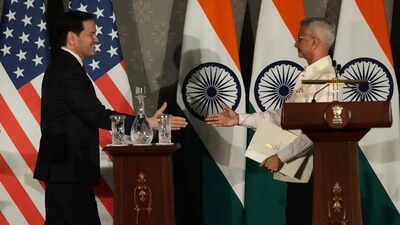
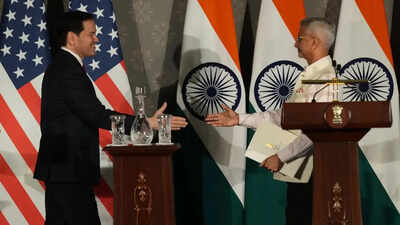
US Secretary of State Marco Rubio and external affairs minister S Jaishankar addressed a joint press conference in New Delhi on Sunday, outlining the growing strategic partnership between India and the United States while also responding to questions on immigration reforms and visa concerns.Speaking at Hyderabad House after delegation-level talks, Rubio said the relationship between the world’s two largest democracies had evolved beyond traditional diplomacy. “A strategic partnership is something very different,” he said. “A strategic partnership is when your interests as two nations are aligned, and you work together strategically to solve those problems.”He added, “The list of issues that we work together with India on, the breadth of scope of them, is what highlights the fact that India is an important strategic partner in the United States, one of our most important strategic partners in the world.”The press conference came a day after Rubio called on Prime Minister Narendra Modi during his ongoing four-day visit to India. Rubio described his first day in the country as “fantastic” and repeatedly stressed that India and the United States were not merely allies, but “strategic allies” with shared interests across defence, trade, energy, technology and counterterrorism.The talks were attended by senior officials from both countries, including Foreign Secretary Vikram Misri, MEA spokesperson Randhir Jaiswal and US Ambassador to India Sergio Gor.
Rubio on visa changes and immigration reforms
Responding to concerns over recent changes to J1, F1 and H-1B visa policies, Rubio said the reforms were part of a broader overhaul of the US immigration system and were “not India-specific”.“First of all, I accept the contribution that Indians have made to the U.S. economy. Over $20 billion has been invested in the U.S economy by Indian companies. We want that number to continue to increase… The changes that are happening now, or the modernisation of our migration system into the United States, are not India-specific; it is global, it’s being applied across the world. We are in a period of modernisation. We’ve had a migratory crisis in the United States. This is not because of India, but broadly, we have had over 20 million people illegally enter the United States over the last few years, and we’ve had to address that challenge… Everything that you do as a country needs to be in your national interest, and that includes your immigration policy.”Rubio further said the US remained “the most welcoming country in the world on immigration” but admitted that ongoing reforms would create “friction points” during the transition period.
Rubio on anti-India hate and racist remarks
Asked about racist comments directed at Indian Americans online and elsewhere in the United States, Rubio said such remarks would be taken seriously while insisting that the US remained an inclusive country.“I’ll take that very seriously about the comments. I’m sure that there are people who have made comments online and in other places because every country in the world has stupid people. I’m sure there are stupid people here; there are stupid people in the United States who make dumb comments all the time. The United States is a very welcoming country. Our nation has been enriched by people who come to our country from all over the world...”Rubio also pointed to the contribution of immigrants to American society and noted that his own parents had migrated to the United States from Cuba in 1956.
Jaishankar on defence, trade and energy cooperation
During the press conference, Jaishankar focused heavily on expanding defence and economic ties between the two countries. He said India and the US had recently renewed their 10-year major defence partnership framework agreement and signed a comprehensive underwater domain awareness roadmap.“Where defence and security cooperation is concerned, you’re all aware that the 10-year major defence partnership framework agreement was recently renewed. A comprehensive underwater domain awareness roadmap was also signed. We discussed the importance of taking into account the Make in India approach and lessons drawn from recent conflicts while going forward in the defence domain.”On trade negotiations, Jaishankar said both sides were pushing for an early conclusion of an interim trade agreement that could eventually pave the way for a wider bilateral deal first envisaged during PM Modi’s US visit in February 2025.
Rubio on Iran
Rubio said significant progress had been made in the last 48 hours on an outline that could lead to the reopening of the Strait of Hormuz and address Iran’s nuclear ambitions.“The president’s preference is to find a diplomatic way. He would much rather have me in the State Department solve this problem than the Department of War having to solve it. But the problem’s gonna be solved one way or the other,” he said.He added that the ultimate goal was to ensure Iran never possesses a nuclear weapon. “They will never possess a nuclear weapon, certainly not as long as Donald Trump is president of the United States.”Rubio suggested there could be “good news in the next few hours” on the straits, but cautioned that work remained. “You can agree to things on paper. They actually have to be implemented. I do think there is some good news on that front, but not final news on that front.”
Jaishankar on energy security
Jaishankar said energy security remained a top priority for India, and diversification of sources was key.“A big country, if you want to de-risk, looks at multiple sourcing. For us, the United States has emerged as a very significant and reliable source,” he said.He added that India would continue to diversify and maintain multiple sources of supply at the most reasonable cost. “We have an obligation to our people to provide them energy at affordable and accessible rates.”
Rubio on US-India trade
Rejecting suggestions that the relationship had lost momentum, Rubio said the Trump administration’s trade policies were applied globally, not targeted at India.“The US-India relationship has not lost any momentum. I understand why some people might say that, but I don’t see it or view that in any way, shape, or form,” he said.He expressed optimism about a trade deal, noting that an Indian delegation had recently visited Washington and a US team was expected soon. “We are hopeful that we will wind up with a trade agreement that is going to be enduring, beneficial to both sides, and sustainable.”
Rubio on Pakistan
On concerns over renewed US engagement with Pakistan’s military leadership, Rubio said Washington’s relationship with other countries did not come at the expense of its strategic partnership with India.“I don’t view our relation with any country in the world as coming at the expense of our strategic alliance with India,” he said.
Jaishankar on multi-alignment
Jaishankar said India was “one of the very few countries” with strong ties to the US, Israel, Iran and Gulf nations simultaneously.“For us, the challenge is how to maintain all these relationships, how to protect our equities, how to advance our interests. We don’t look at it as a zero-sum game. We have to manage and actually take care of all these accounts,” he said, adding that India’s approach is guided by peace, stability, lower energy prices and safe maritime commerce.
Rubio and Jaishankar on Quad
Rubio called the Quad “a form of alignment between four countries who are not just strategically aligned, but four countries that have the ability to influence global events on these topics of mutual interest.” He thanked Jaishankar for hosting the May 26 foreign ministers’ meeting.Jaishankar said the terms “maritime” and “democracies” were both relevant to the Quad’s cooperation. “We are doing a lot with each other because we are maritime powers, and I see that growing. And we are doing a lot with each other because we are democratic powers. For us, particularly in the Indo Pacific, it’s very important that the core cooperation as maritime democracies continue, and that is exactly what you will see.“