









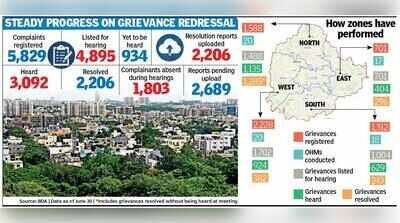
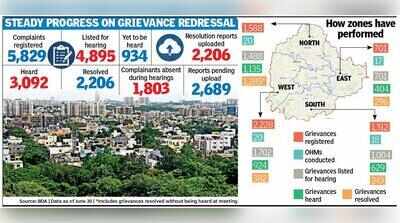
Bengaluru: Bangalore Development Authority’s (BDA) Open House Meeting (OHM) initiative, launched to resolve long-pending citizen grievances, has made a promising start, though official data suggests there is still considerable ground to cover.Launched in Aug 2025 and conducted by BDA’s Citizen Action Cell (CAC), the initiative had heard 3,092 of the 5,829 grievances registered across the city’s four zones as of June 30.According to BDA data, 75 OHMs have been held so far. Of the 4,895 grievances listed for hearing, 3,092 were heard and 2,206 resolved. Among the four zones, West recorded the highest number of grievance registrations at 2,228, followed by North (1,588), South (1,312), and East (701).Officials said the grievances brought before the OHMs cover a wide range of issues, including allotment of alternate sites, duplicate site allocations, undated allotments, and decades-old layout discrepancies dating back to a time before digitisation and drone surveys. Many of these cases stem from poorly documented layouts, resulting in issues such as the same site being allotted to multiple people or land already being encroached upon.Several citizens who spoke to TOI appreciated the platform but said there was still scope for improvement.A 44-year-old resident of Thalaghattapura said, “The platform allows the public to speak directly to the officer concerned in the presence of senior officials. The videoconferencing facility and livestreaming of meetings also bring greater accountability. However, there are areas where OHM still needs improvement, particularly policy-level issues. We’ve raised complaints regarding BDA jurisdiction in GBA areas, occupancy certificate issues, sanction plan revisions, EWS reservation cancellation circulars, and the process of handing over BDA-relinquished land to registered apartment RWAs, but these haven’t yet been resolved.”BDA chairman NA Haris said, “This has ensured complete transparency, significantly curbed corruption, and given people the confidence that if their grievance is not resolved or if anyone demands money, they can return to any number of OHMs by simply calling the helpline, getting a slot, and presenting their case openly before the officials concerned.”How system worksBDA officials said the grievance redressal system was introduced to make complaint resolution more transparent, accountable, and accessible. Earlier, citizens often struggled to identify the appropriate officer, officials were not easily accessible, and there was no structured escalation mechanism, leaving many grievances unresolved for years.Under the new system, complaints are categorised based on their complexity. General queries are addressed over phone, specific complaints are resolved within 24 hours, and urgent but more complex issues are taken up within seven days. Cases involving policy decisions or multiple departments are escalated to the OHM.Officials said the initiative has received a far greater response than expected, with grievances pending for anywhere from five to 45 years coming to light. Initially held once a week, the meetings were briefly expanded to almost daily across the city’s four zones to clear the backlog; they are now conducted twice a week. BDA has also begun resolving simpler grievances through inter-departmental coordination before they reach the OHM stage, sparing citizens the need to attend hearings in person.