





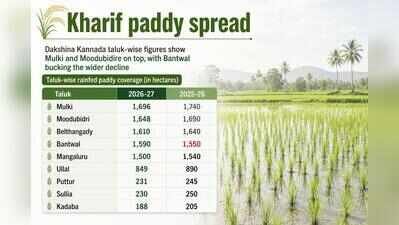
Mangaluru: Falling water levels in wells and tanks have made Dakshina Kannada’s second, or rabi, paddy crop uncertain, with a farmer representative estimating that only half the area could be sown if rainfall does not improve.Farmers expect second-crop sowing from late Nov through Dec, though it has already begun in some areas. The crop takes 90 to 100 days, compared with around 120 days for the first crop.Honnappa Gowda, joint director of agriculture, Dakshina Kannada, said the second crop was particularly uncertain for farmers without reliable irrigation.Rajavarma Bylangady, former president of Krishi Vichara Vinimaya Kendra, estimated that farmers could sow only half the area for the second crop if rainfall did not improve.He said paddy prices had risen from Rs 2,000 to Rs 3,800-Rs 4,000 per quintal in two years. Parboiled red rice sold at Rs 60-Rs 75 per kg and could reach Rs 80-Rs 100 if the second crop failed.The uncertainty follows a marginal decline in rainfed paddy cultivation in the district during the 2026-27 kharif season amid delayed rainfall.Agriculture department figures show rainfed paddy covered 9,542 hectares, down 208 hectares, or 2.1%, from 9,750 hectares in 2025-26. The target was 10,000 hectares.Mulki and Moodubidire taluks led the district in rainfed paddy cultivation. Mulki recorded 1,696 hectares, followed by Moodubidire with 1,648 hectares.Gowda said delayed rain affected sowing, particularly in Bantwal and Belthangady. Rain picked up around mid-June and continued into July.He said paddy cultivation was limited as much of the district’s farmland was under plantation crops. The district relied on supplies from Chikkamagaluru and Shivamogga to meet local demand.Despite the initial rain shortage, some farmers reported higher yields than last year.“Despite the initial shortage of rain, this has been a good first crop. In my case, I harvested around 15 quintals of paddy per acre this year, compared to about 10 quintals last year,” Bylangady said.He said higher yields did not mean more land was under cultivation.Jinendra Hegde, a farmer from Moodumarnadu in Moodubidire taluk, said rains after delayed sowing helped the crop recover, with most first-crop farmers nearby reporting good results.