











Bengaluru: In a bid to promote healthier eating habits among children, Karnataka govt Friday announced a ban on sale, free distribution, advertisement and promotion of high fat, sugar and salt (HFSS) food products within school and pre-university college campuses, canteens and a 50-metre radius around them. The move comes just after Maharashtra issued a similar order.While the intent behind the order has been welcomed, it has also raised a key question among school managements: What exactly qualifies as junk food? The advisory does not specify the list of prohibited food items, leaving educational institutions and vendors unsure about what can and can’t be sold.“This is a welcome move. However, the big question is whether govt has released a list of junk foods. What are the criteria? Is a vegetable or chicken sandwich considered junk food?” asked D Shashi Kumar, secretary, Association of Managements of Primary and Secondary Schools of Karnataka (KAMS).He also questioned how the ban would be enforced outside school premises. “Schools with food stalls on their campuses can regulate what is sold. But how will authorities control food sold outside schools, especially in Bengaluru, where malls, restaurants and other eateries are located close to educational institutions?” he asked, adding that implementation should focus on improving children’s health rather than becoming merely an enforcement exercise.Health minister UT Khader said a more detailed list of prohibited food items will be issued. “We know that foods like popcorn and chikki are healthy options for children. Likewise, we know that foods high in sugar, salt and transfats are harmful. This is only the first phase of implementation aimed at preventing lifestyle diseases. We will issue further guidelines as and when required,” he pointed out.Explaining the rationale behind the decision, Khader said children are more likely to choose food based on taste rather than nutritional value. “When adults buy food items, they know what is safe and understand its impact on health. But for children, it is more about taste, and they do not check other parameters,” he said, adding that educational institutions and relevant trade bodies will be served notices and directed to implement the new norms immediately.ONUS ON SCHOOL MANAGEMENTSThe advisory places the responsibility on school managements to ensure HFSS food products are not sold on their premises and mandates installation of prominent warning signboards discouraging their sale. It also requires food vendors, bakeries, hotels, canteens and other establishments operating near schools to have valid Food Safety and Standards Authority of India (FSSAI) licences and comply with prescribed food safety and hygiene standards. Food safety officers have been directed to conduct regular inspections and initiate legal action against establishments found violating rules.“Our officers will carry out random inspections of school canteens and establishments around schools. Violators can be fined up to Rs 3 lakh under Food Safety and Standards Act, 2006. We urge parents to alert us if they find junk food being sold in or around schools. We are confident that all stakeholders, including school managements, will cooperate in the interest of children’s health,” Khader said.He said the state govt is in discussions with education department on the possibility of not renewing recognition or licences of schools found selling junk food from the next academic year.
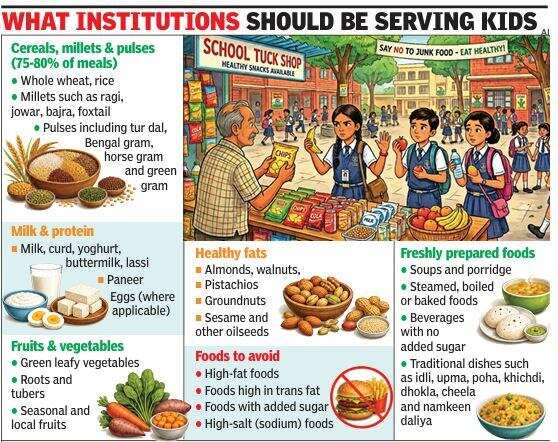
What to and not to serve
Hot water to be served in all restaurantsIn view of ongoing monsoon and seasonal spike in water-borne diseases, health minister UT Khader said restaurants and eateries across Karnataka — from small darshinis to star hotels — should serve only hot or warm drinking water to customers.The practice is common in neighbouring Kerala, where most restaurants serve hot/warm water by default, a tradition rooted in the belief that it aids digestion and helps reduce risk of water-borne illnesses.Khader said while the practice will be mandated during monsoon, it will be desirable for eateries to continue serving hot or warm water throughout the year as a food safety measure.