










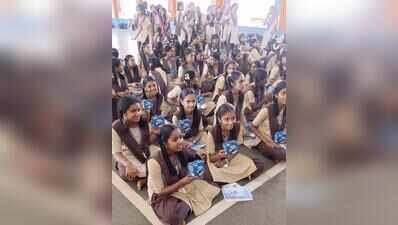
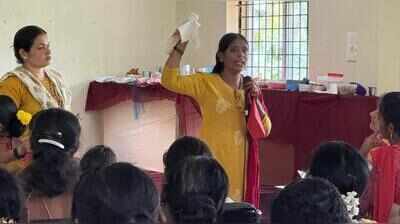
Mangaluru: An initiative launched to tackle waste-management challenges in 10 gram panchayats in Dakshina Kannada has evolved into a campaign promoting menstrual health, dignity and environmental sustainability.After finding that used sanitary pads were frequently mixed with household waste, Hasiru Dala, an organisation working towards socio-economic inclusion, shifted its focus to awareness and behavioural change. It began conducting menstrual hygiene workshops at gram panchayats, schools, colleges, anganwadi centres and women’s self-help groups, encouraging women and adolescent girls to adopt reusable menstrual products.Hasiru Dala Project trainer Rekha Priya said that women are provided with menstrual cups, while adolescent girls receive reusable cloth pads. Menstrual cup users are also added to dedicated WhatsApp groups, where trained resource persons answer questions and help first-time users overcome their hesitation. Follow-up counselling and additional training are offered to those who are initially reluctant to use the cups, she said.The scientific management of household waste remained one of the biggest challenges facing gram panchayats and the disposal of used sanitary pads and disposable diapers was among the most difficult aspects of solid-waste management, she added.Hasiru Dala launched the zero-waste model gram panchayat project with the support of the Dakshina Kannada zilla panchayat, SBI Foundation Conserw. Under the project, women from the Sanjeevini Federation collect segregated household waste through door-to-door visits. Biodegradable waste is processed into organic compost at solid-waste management (SWM) facilities, while dry waste is further segregated and sent for recycling and resource recovery.However, they noticed that the social stigma surrounding menstruation makes many women reluctant to discuss menstrual hygiene or dispose of used products separately. Consequently, sanitary pads are often mixed with wet or dry waste, complicating manual segregation and exposing women working at SWM facilities to health and hygiene risks. Hasiru Dala therefore decided to treat the problem not merely as a waste-management concern but also as an issue involving women’s health, dignity and environmental sustainability, said Hasiru Dala project manager Nagaraj Ragav AnchanSo far, in a year, 47 menstrual hygiene management programmes have benefited more than 4,000 women and adolescent girls. Menstrual cups have been distributed to 1,680 women, while 1,122 adolescent girls have received reusable cloth pads. Several participants later purchased reusable menstrual products themselves after learning about their health, environmental and economic benefits, Anchan said.Hasiru Dala has also launched Hasiru Hejje, an awareness programme for mothers of children below four years. Conducted through anganwadi centres, the sessions use presentations and demonstrations to explain the health and environmental effects of excessive dependence on disposable diapers. Mothers are encouraged to use reusable cloth diapers wherever feasible.According to Hasiru Dala, sustained awareness efforts have reduced the quantity of used sanitary pads reaching SWM facilities by nearly 50%. Women who switched to menstrual cups have also reported greater comfort, better menstrual hygiene and lower recurring expenses.