









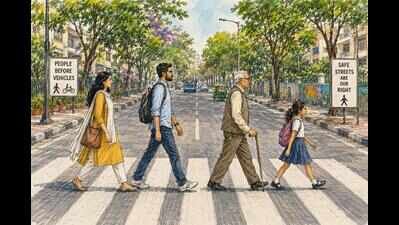
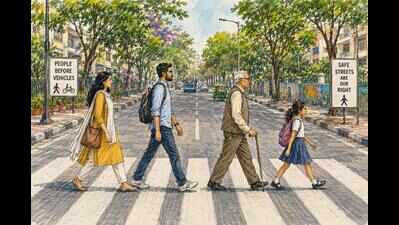
Bengaluru: More than four years before the Supreme Court observed that safe walking is part of the fundamental rights guaranteed under Articles 21 and 19(1)(d), Karnataka had prepared a draft active mobility Bill in Dec 2021.The Bill, drafted by the Directorate of Urban Land Transport (DULT), stated: “Individuals shall have the right to complete and connected streets and the right to access any place in an urban area by walk or by cycle.”While the SC, in its June 19 ruling, called for a dedicated law to protect pedestrians, Karnataka has been sitting on its draft Bill for years. The draft, in 17 chapters and 55 sections, seeks to make safe walking and cycling statutory obligations.Besides making recommendations, the draft prescribes timelines and accountability. Municipal corporations must prepare comprehensive mobility plans within two years. Urban local bodies must conduct annual infrastructure audits and regular walking inspections, with physical and digital records maintained.These are specifically required to identify issues faced by women, children, senior citizens, and persons with disabilities.Chapter 15 has the strongest provision. It gives pedestrian and cycling infrastructure “first charge” on municipal funds — the kind of protection that matters when budgets get squeezed. The Bill creates grievance-redressal systems and empowers authorities to levy fines of up to Rs 1 lakh, rising to Rs 2 lakh for repeat violations. Even govt departments can be held liable.The top court has provided the constitutional backing. Karnataka already has the legislative blueprint. The missing piece is political urgency. Any delay means pedestrians are forced off broken pavements, onto carriageways and into harm’s way.FOR SAFER STREETS & FOOTPATHS* Create new streets with footpaths and cycle tracks; do not retrofit* Redevelop existing roads to incorporate walking, cycling infrastructure* Drivers, by law, must yield at crossings; not a courtesy expectation* Streets must prioritise movement of people over vehicles* Footpaths must be continuous, unobstructed, well-lit, and accessible* Must have kerb ramps, pedestrian-refuge islands, dedicated signal phases, and traffic-calming measures* No agency can set up temporary or permanent structures on footpaths* During construction work, safe detours must be provided* Motorists prohibited from parking on footpaths* Treat residential areas, school zones, and hospital zones as ‘slow streets’; speeds capped at 20kmphNeeded: Walking clusters, infra studyThe govt must table the Bill on priority and follow the TenderSURE model for its implementation. Start small, and create walking clusters in neighbourhoods across Bengaluru. If we do this in 12-15 locations, every part of Bengaluru will have at least one walkable cluster. It can be completed within 22 months and will cost far less than building elevated roads. Pedestrians should get priority over vehicles. The world over, good cities make space for footpaths and then plan the road for single-lane traffic: Ashwin Mahesh, urban planning expertGBA has involved Sensing Local in assessing roads and footpaths. The mapping exercise for Central and South is nearly complete. We should have a good idea about the entire city in a month. While a GIS-based road infrastructure management system is being designed to improve planning and maintenance by integrating details beyond just road alignments, we must map footpaths, bus stops, flyovers, underpasses, and other infrastructure so that we can track roadworks, flooding, defect-liability periods, and maintenance through an automated system: Sobia Rafiq, urban planner from Sensing Local.The key issue with walkability is not lack of footpaths, but that they aren’t walkable because of maintenance issues. Road-maintenance contracts don’t include footpaths. Our approach is reactive. Earlier, footpaths and roads were clubbed together in budgets. When the choice was left to the contractor, footpaths got lower priority. In 2025, for the first time, BBMP declared 1,000km of footpaths will be made walkable. After the formation of five corporations, each ward has a say in road and footpath works even in arterial roads. The draft Bill is excellent. Not having dedicated legislation is not an excuse: Arun Pai, of Project Walkaluru.