










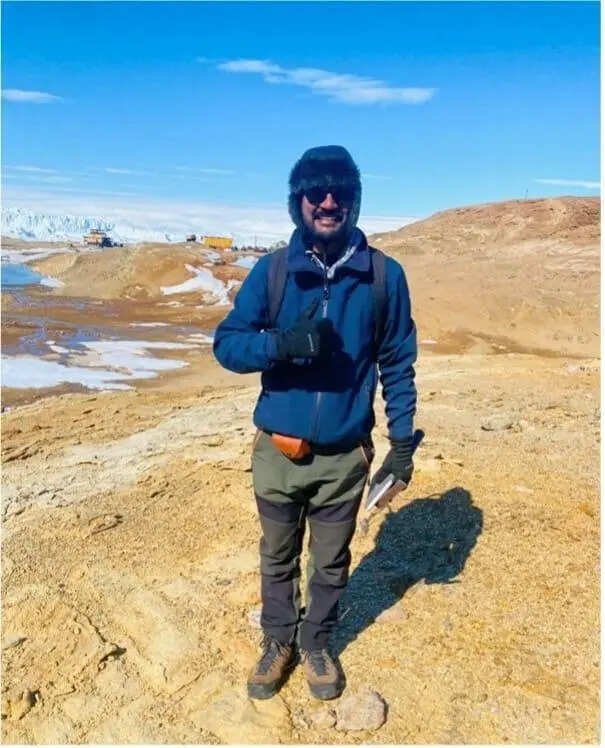

Udupi: Three researchers from Manipal Academy of Higher Education (MAHE) have returned after a scientific journey to Antarctica, where they spent about three months conducting research as part of India’s polar mission. The 45th Indian Scientific Expedition to Antarctica, organised under the aegis of the National Centre for Polar and Ocean Research (NCPOR) and funded by the ministry of earth sciences (MoES), saw Dr Aditya Udayraj Joshi, Santhosh Prabhu and Runkob Srimani contribute to diverse scientific studies ranging from ancient continental linkages to modern environmental concerns.Dr Joshi, assistant professor at MIT and the principal investigator of his project, focused on studying rock formations in the Larsemann Hills region of East Antarctica. By collecting and analysing these samples, he aims to uncover clues about the ancient connection between India and Antarctica, once part of the same supercontinent. “Similar rock formations are found in India’s Eastern Ghats and East Antarctica. By studying them, we can determine the exact point and time when the two landmasses split and understand the movement of tectonic plates,” he told TOI. Advanced techniques such as paleomagnetism, anisotropy of magnetic susceptibility and radiometric dating will be employed once the samples arrive in India. PhD scholar Ayushi Udgata will also be working on these samples. The team travelled from Goa to Cape Town, and from there boarded a specialised aircraft capable of landing on ice and undertook an eight-hour flight to Antarctica. Dr Joshi was stationed at India’s Bharati research station for over three months, undertaking daily field expeditions, often trekking several kilometres in harsh winds and subzero temperatures, to collect rock samples. Dr TMA Pai research scholars Srimani and Prabhu focused on environmental monitoring, collecting lake water samples around Maitri, and seawater, lake water, wastewater and sea ice samples from areas surrounding the Bharati research station. Bharati and Maitri are India’s two active, permanent scientific research stations in Antarctica, managed by NCPOR. Their work aims to detect the presence of emerging contaminants, such as pharmaceutical residues, antibiotics and persistent chemicals like PFAS (per- and polyfluoroalkyl substances), in Antarctic ecosystems. “We want to understand how far human-induced pollutants have reached even in such a pristine environment,” Srimani said. Due to logistical challenges and the limitations of carrying heavy instruments, initial processing was done on-site, while detailed analysis will be conducted in India once the samples arrive by ship. Srimani said: “The facilities at the research station made our stay comfortable. Collection of samples from around Bharati station was done for an extended period, during the frozen sea condition and later after it melted. Prabhu used to walk on the frozen sea and collect the samples; when it melted, he had to do this via helicopter, which arrived by the ship.” Dr Balakrishna, dean of the School of Civil and Chemical Engineering in MIT, is guiding the research scholars.